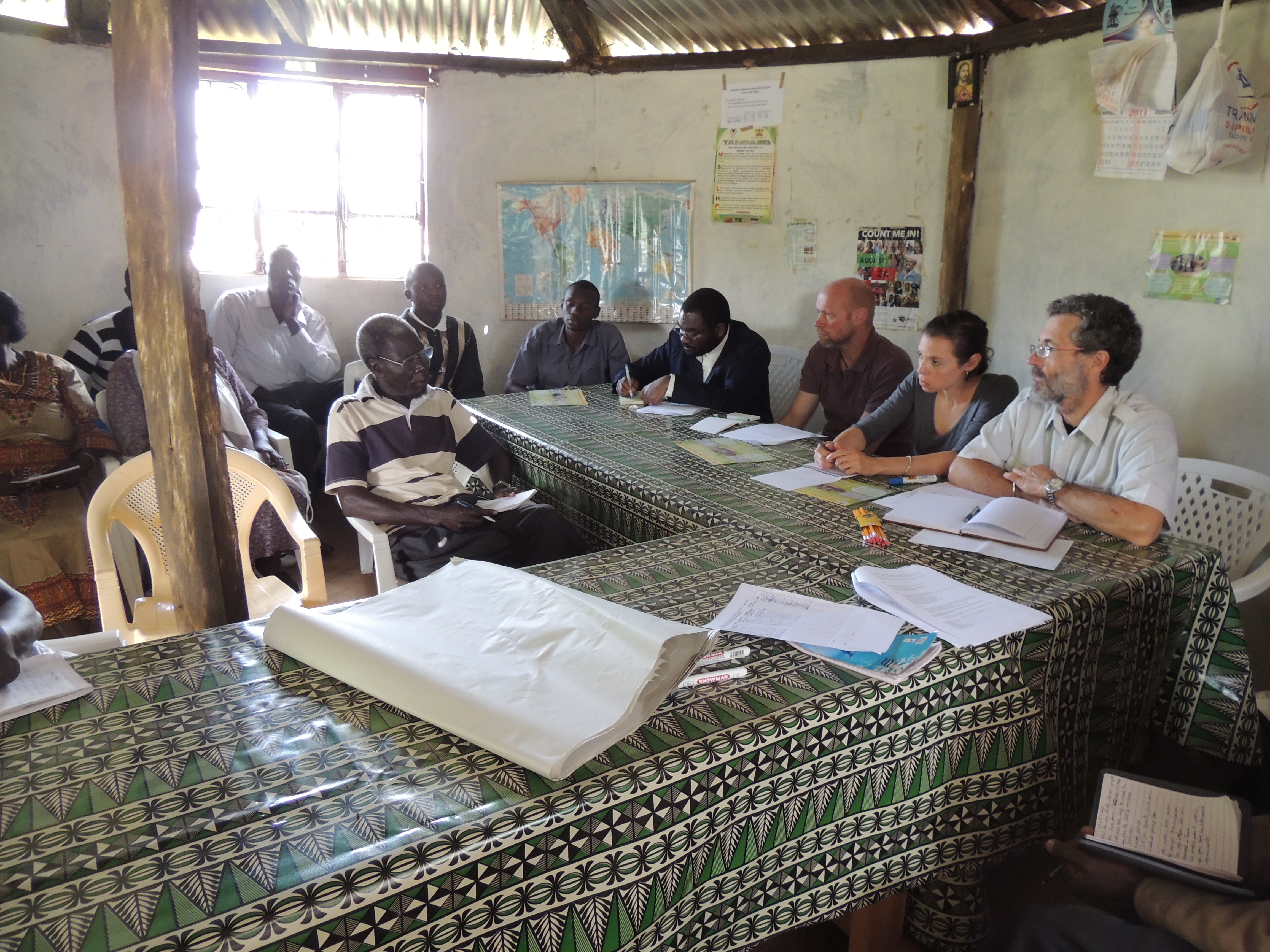
Working with a multi-organizational, multi-national team on challenges associated with marketing on a conservation agriculture project.
Working with a multi-organizational, multi-national team on challenges associated with marketing on a conservation agriculture project.
The following is not written from a privileged vantage point. But as it appears to me, privileged vantage points are not so obvious in business anthropology. Contributors to this enterprise occupy such diverse roles and engage such varied projects none of which can claim dominance. A handful pursue academic anthropological careers; another band are scattered about in business schools in North America and Europe; an entrepreneurial troop make their living in diverse management consultancy practices; a significant number are oriented towards public service in the tumultuous NGO community; and a final tribe are attached to major corporate enterprises again in a range of niches. Moreover, newcomers seem to spring from across an array of anthropological graduate programs which generally display no special commitment to the enterprise of business anthropology. That we recognize these sometimes distant affinal relations through this new journal and the slightly less newborn EPIC powwows is remarkable testimony to a desire for voice, point of view, and legitimate seat at the anthropological table. What follows are some respectful if slightly polemical comments intended to stimulate rejoinders and other reflections.
Business Anthropology as Resistant Practice
Insofar as it insists upon the cultural as a fundamental epistemological and ontological premise, as I strongly believe it should, business anthropology must always be pushing uphill against two dominant instances, even institutions of bourgeois cultural expression. This view is inspired by Sahlins (1976) perceptive, but perhaps neglected essay. As Sahlins (1999) has more recently noted, culture has fallen out of favor in anthropology, but should not do for the very good reasons he suggests. One of the two instances, the cultural trope should confront is emic notions of psychology, and even much of the academic variety, which enshrines the individual as the timeless and universal subject and object of knowledge and meaningful action against all the evidence of anthropology. Following Sahlins and Marcel Mauss before him (1938), we should see this as a cultural model, not a natural one. The other instance is economics, which enshrines a certain abstract ideal of action as teleology, based moreover on an empirically falsifiable myth about the origin of money and economic behavior more generally (Graeber 2011). In other words, business anthropology should push back against the relentless naturalizing of these cultural expressions, both because this is where anthropology gains its competitive advantage as a source of practical insight, and because this perspective is critical for promoting theoretical insights. That is, when anthropologists insist on the socially and culturally embeddedness of individual action, and elucidate the particular contours of that embeddedness we generate insight. Similarly, when we elucidate the manifold ways in which things are produced, circulated, and disposed in dialectic interaction with social and cultural contexts we similarly generate telling insight. And now comes around again a third orientation to resist, that of behavioral determinism enshrined in a misreading of human biological systems as pre-cultural ones, i.e., neuro-marketing (Schneider and Woolgar 2012). The anthropological insistence on the priority of meaning, those webs of significance, Geertz (1973) colorfully revealed, has to some degree carried the day in forward thinking businesses. But there is much danger that the cultural turn (Sherry 1991) in business thinking will be replaced by a neuro-biological turn unless business anthropology mounts a serious critique of biological determinism. In this way, the American branch of business anthropology can reassert a commitment to the Boasian critique of simplified social Darwinism, while building on recent research in the anthropology of mind and body.
Business Anthropology as Reflexive Practice
Business anthropologists, like cultural anthropologists, always require for their success no small measure of reflexivity. This is of necessity a two tracked process; on the one hand, the ethnographic and ethnological track that asks “what is going on here,” given the boundaries of the dominant paradigms of bourgeois culture. So what is being asked of the business anthropologist, the assignments she is given, the testimony she is invited to give, the insight she is invited to provide will always be assessed in terms of these paradigmatic boundaries. And so the business anthropologist has to think tactically about how to frame, by for example finding ways to put executive decision makers within the experiential frame of their customers, and how to provide the culturally deft metaphor that makes the strange blindingly obvious to executive decision makers. In the former case, I think for example, of point of view videography that illustrates the isolation, interminability, and lack of information the average visitor to the emergency room may face. In the latter, I think of revealing to execs that everyday consumer goods in the US context, are jokingly referred to as wedding presents in a Latin American context to bring home their cultural impropriety.
Business Anthropology as Handmaiden of Innovation
Of course, anthropological insight has been central to the innovation process in devising new products and services and even service systems, but going forward may well turn its attention to a larger project. Business is not what it used to be, or at least the commitment to a single firm based model of business practice has been destabilized in recent years. And so it is possible to imagine that all of the alternative market forms that currently constitute a tiny fraction of the world of business, and in which anthropologists sometimes find a role as advisors and advocates (Fair Trade, Community Supported Agriculture, social enterprise, microfinance, rural sales programs) may evolve towards some thing or things other than the capitalist forms nurtured into florescence in the 19th and 20th centuries. Can anthropological expertise in community, household, (kinship) networks, the gift, cultural ecology, and social reproduction help us imagine new modes of value creating systems? Here additional foundational work seems that of students of globalization processes, but also a serious insistence in our field upon the ways in which definite commercial forms of material practice are viewed as legitimate, culturally specific modes of action.
Business Anthropology as a Theoretical Project
And thus, the other reflexivity, which is that of anthropology as heir to robust intellectual traditions dating back 250 years to the Enlightenment. The meta lesson of George Stocking’s many labors on the history of anthropology should inspire business anthropologists to drink deeply and promiscuously at the well of anthropological thought. Cataloguing here all the theoretical contributions and their contemporary reverberations anthropologists have made would end in reproducing something like Borges’ map of the world. But the general point is that business anthropology should be first and foremost edifying, anthropological theory and not the poor step child of management, marketing, finance or accountancy or simply reduced to a method for rendering such practices more efficient and effective. Thus, for example, much theoretical work has been produced on consumption by scholars affiliated with the consumer culture theoretical tradition, the material culture school at University College London, the sociology of consumption nurtured at the Birmingham School, and so on. But I do not see much evidence that this work has become part of a shared theoretical vocabulary across the diverse sub-tribes of business anthropologists referred to at the outset. We also have some wonderful if scattered work on finance, management, HR, and the like, catalogued in Ann Jordan’s (2011) heroic text, but these are theoretically sparse I think. Objects like The Audit Society (Power 1997), Collateral Knowledge (Rise 2011), and a current favorite Donner et Prendre (Alter 2009; see also Batteau 2000) which reveals the theoretical insights on organization to be derived from Maussian exchange theory, perhaps point some ways towards more theoretically robust contributions. Thus while Grant McCracken (2009) has called for the institutionalization of a Chief Cultural Officer, he has neglected the problem that such a CCO would have a relatively limited theoretical tool kit to draw on in addressing various business sub-cultures, logics, and projects compared to competing C-suite colleagues in finance or engineering for instance. Perhaps JBA or EPIC might host reflections or workshops on the relevance of particular theorists for business anthropological practice.
Reflexivity Again
Reflexivity is also important in assessing the nature of practice. For example, a recent ethnographic research project turns up strong evidence that one of the products of ethnographic fieldwork in business to consumer marketing research is what might be called figurations of target markets (rather than representations) that resemble the fetishes devised in analogizing ontological contexts (Cayla and Arnould, n.d.; Descola 2005). These heterodox boundary objects circulate through firms and across departmental boundaries and seem to assume an ambiguous power to organize the practice of teams of designers and engineers subsequent to their creation. These and other such anthropological objects produced through business ethnographic practice merit epistemological, ontological and ethical reflection. Here the contributions of Latour and Callon’s actor network perspectives seem of self-evident theoretical and practical value. That is to say, our research should examine how ethnographic products are appropriated and assimilated into systems of organization knowledge and knowledge management.
At a more general level if I may risk a critical tone, it seems to me that in reviewing canonical texts (Jordan 2011) that case studies in business anthropology are perhaps somewhat over committed to ontological realism, and that the re-recognition of the mythic, magical, narrative, ontologically challenging, and dare I say tribal dimensions both of business and business anthropological praxis would be of some value. In other words bringing in again the lessons of Writing Culture to the work we do as business anthropologists may be of value. This is something quite different than some theory-denying postmodernism however, rather a recommitment to reviewing the insights foundational social philosophers like Marx, Mauss, the Frankfurt School, Foucault, Luhman, Bauman, Morin, Bataille, Baudrillard, Weiner, and others may offer in probing deeper into what we do.
Conclusion
Business anthropology may act more forcefully on the strength of its own convictions, for like other of the hybridized anthropologies of agriculture, medicine, development, education, or health, it fosters the virtue of being in the world as it is rather than how it was or how we might like it to be. As some sociologists have been perhaps quicker to recognize we live in a globally marketized cultural ecosystem whether we like it or not. This must be the subject of an anthropology that wishes to avoid the antiquarianism and solipsism that always threatens a discipline for which reflexivity has become so key since the postcolonial turn. And this means that there should be interconnecting networks of knowledge production and communication, an anthropology of business, an anthropology for business, and a business for anthropology all theorized as such, as well as a critical school of all of them. To achieve this, not only may discussion and debate be encouraged in the pages of JBA and in sessions at EPIC and other anthropological conferences, but more robust academic programs are required such as the University of Southern Denmark’s brand new degree in Marketing Management and Anthropology. Further, those who have achieved success may well wish to endow scholarships or programs in business anthropology at top degree granting institutions.
References
Alter, Norbert (2009, Donner et Prendre : La coopération en entreprise, Paris : La Découverte.
Batteau Allen W. (2000), “Negations and Ambiguities in the Cultures of Organization,” American Anthropologist, 102 (December), 726-740.
Cayla, Julian and Eric J. Arnould (n.d.), Consumer Fetish: The Symbolic Imaginary of Consumer Research, Sydney: Australian Graduate School of Management.
Clifford, James and George E. Marcus (1986), Writing Culture: The Poetics and Politics of Ethnography, Berkeley and Los Angeles: University of California Press.
Descola, Philippe (2005), Par-delà nature et culture, Paris : Gallimard.
Geertz, Clifford (1973), The Interpretation of Cultures, Boston: Basic Books.
Graeber, David (2011), Debt: The First 5000 Years, Melville House.
Jordan, Ann (2013), Business Anthropology, 2nd edition, Long Grove, IL: Waveland Press.
Mauss, Marcel (1968/1938), A category of the human spirit: the notion of the self, Psychoanalytic Review, LV, 457-481.
McCracken (2009), Chief Culture Officer: How to Create a Living, Breathing Corporation, Boston: Basic Books.
Power, Michael (1997), The Audit Society: Rituals of Verification, New York: Oxford University Press.
Ries, Annelise (2011), Collateral Knowledge, Legal Reasoning in the Global Financial Markets, Chicago: University of Chicago Press.
Schneider, Tanja & Steve Woolgar (2012), “Technologies of ironic revelation: enacting consumers in neuromarkets,” Consumption Markets & Culture, 15 (June), 169-189.
Sherry, John F., Jr (1990), “Postmodern alternatives: the interpretive turn in consumer research,” Handbook of consumer behavior,” in Handbook of Consumer Behavior, Thomas S. Robertson and Harold H. Kassarjian, eds, Englewood Cliffs, NJ: Prentice Hall, 549-591.
 mktganthropology